
Revenue Strategy
You're Spending to Grow. But Are You Spending to Keep?
Acquisition gets attention. Retention protects revenue. The businesses that scale profitably run both, but fix retention first.
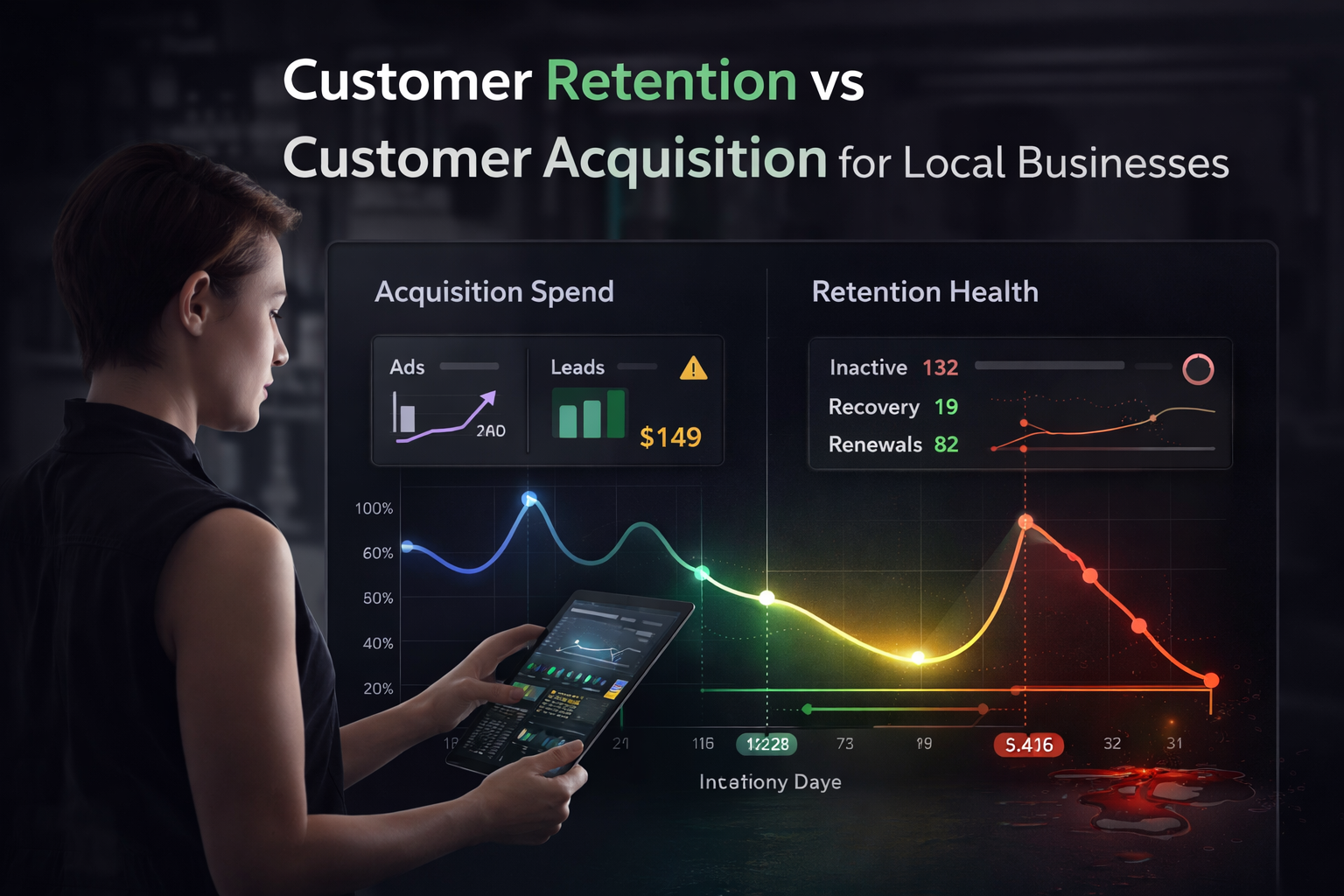
The Gap Most Businesses Don't See Until Revenue Slips
Most local business owners have run ads, boosted posts, offered referrals, or hired someone for social media. They know what acquisition costs in money, time, and energy.
Far fewer have a reliable system to keep the customers they already paid to acquire. That is the gap, and it is more expensive than most teams realize.
Two Strategies. Very Different Economics.
Customer acquisition brings new people in through ads, referrals, walk-ins, promotions, and word of mouth. Customer retention keeps existing customers returning through consistency, follow-up, and timely re-engagement.
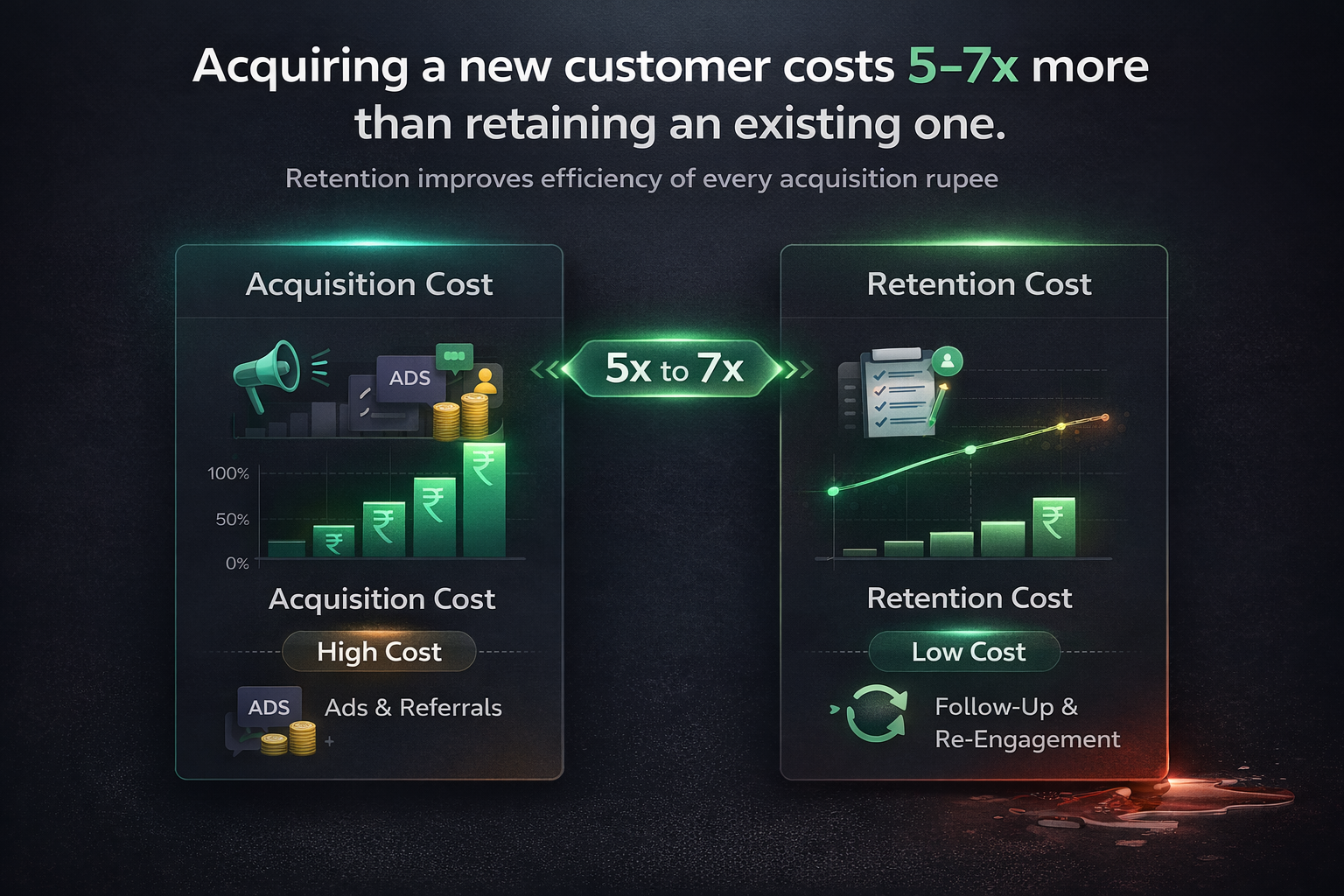
Both matter, but they do not cost the same. Acquiring a new customer often costs 5 to 7 times more than retaining an existing one. Yet many gyms, salons, clinics, and coaching centers still spend heavily on acquisition while retention runs on staff memory and occasional broadcasts.
The Leaky Bucket Problem
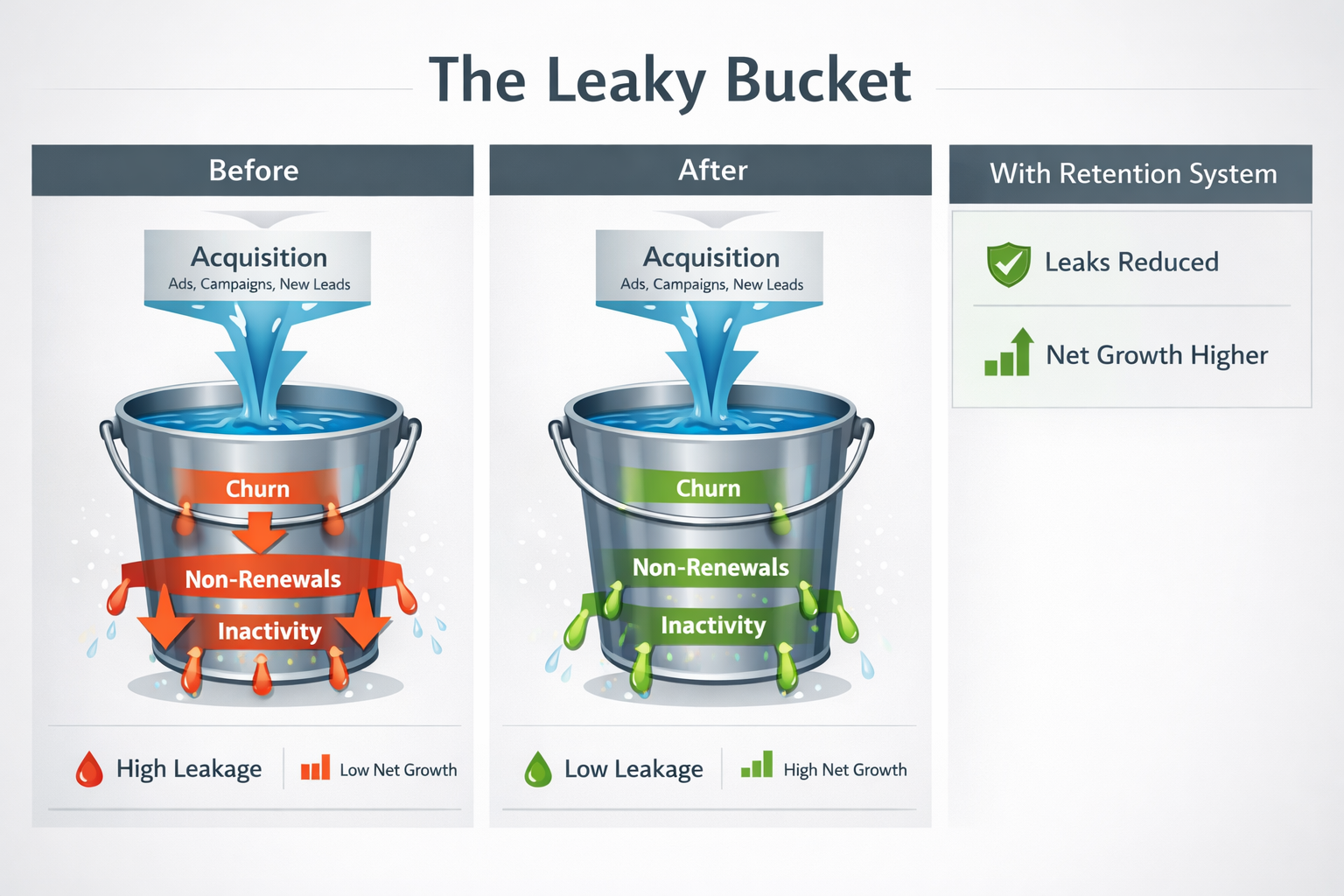
Think of your business as a bucket. Acquisition is the tap: leads, enquiries, offers, new customers. Retention is the bucket: how well you hold what you already earned.
Many local businesses run the tap at full pressure while ignoring holes at the bottom. You add 20 new customers this month but lose 15 quietly through inactivity and missed renewals. Net growth becomes five, despite high spend.
If those 15 had been detected earlier and even 10 were recovered, net growth jumps to 15 with far better marketing efficiency. That is the retention advantage: not replacing acquisition, but multiplying it.
What Existing Customers Are Actually Worth
The biggest blind spot is customer lifetime value. A salon client who visits monthly for two years is worth 24 visits. Lose her after three months and she is worth only three.
The loss is not just missed visits. It is referrals not made, add-on services not purchased, and trust not compounded. Acquisition starts the relationship. Retention extends the revenue.
Bain & Company research shows that even a 5% retention improvement can drive significant profit gains. That is the compounding power of customers who stay longer, buy more, and refer others.
Why Acquisition Gets All the Attention
Acquisition is visible. You can see campaigns, count enquiries, and feel launch momentum. Retention is quieter until it fails.
You do not notice the 12 people who silently did not renew this month. You notice the revenue gap weeks later, when the recovery window is smaller. That is why many teams over-invest in front-end growth and under-invest in back-end retention.
The Businesses That Win Run Both — But Fix Retention First
High-performing local businesses do not choose acquisition or retention. They run both. But they fix retention first because filling a leaking bucket faster is not a growth strategy.
Before increasing ad spend, they ask:
- How many customers did we lose last month that we could have kept?
- What early signals did we miss?
- Do we have a system that detects inactivity before churn becomes permanent?
Most teams care about these questions, but manual tracking cannot reliably answer them at scale.
This Is Exactly the Problem Auto Re Engage Solves
Auto Re Engage is built for local service businesses that have customer data but no retention engine. It continuously monitors visit frequency, last activity, renewal timelines, and engagement patterns.
When customers start going quiet, it flags them as at-risk early. You can then trigger personalized WhatsApp re-engagement campaigns to exactly those customers instead of mass-broadcasting everyone.
The outcome is simple: more recovered customers, less silent churn, and stronger ROI from every acquisition rupee.
A Tale of Two Studios
Two fitness studios in the same city run the same ₹15,000/month ad budget.
Studio A acquires 25 members but loses 20 quietly. Net growth: five. Effective acquisition cost per net member: ₹3,000.
Studio B also acquires 25, but uses Auto Re Engage to recover 14 of the 20 at-risk members. Net growth: 19. Effective acquisition cost per net member drops to under ₹800.
Same budget. Different system. Radically different result.
Key Takeaways
- Acquiring new customers is usually far more expensive than retaining existing ones.
- Many local businesses over-invest in acquisition and under-invest in retention systems.
- Customer lifetime value drives long-term revenue stability, not first purchase volume alone.
- Retention does not replace acquisition; it makes acquisition more profitable.
- Customer inactivity is detectable early only when a system monitors behavior continuously.
- Fixing the leaky bucket before increasing spend is the smarter growth move.
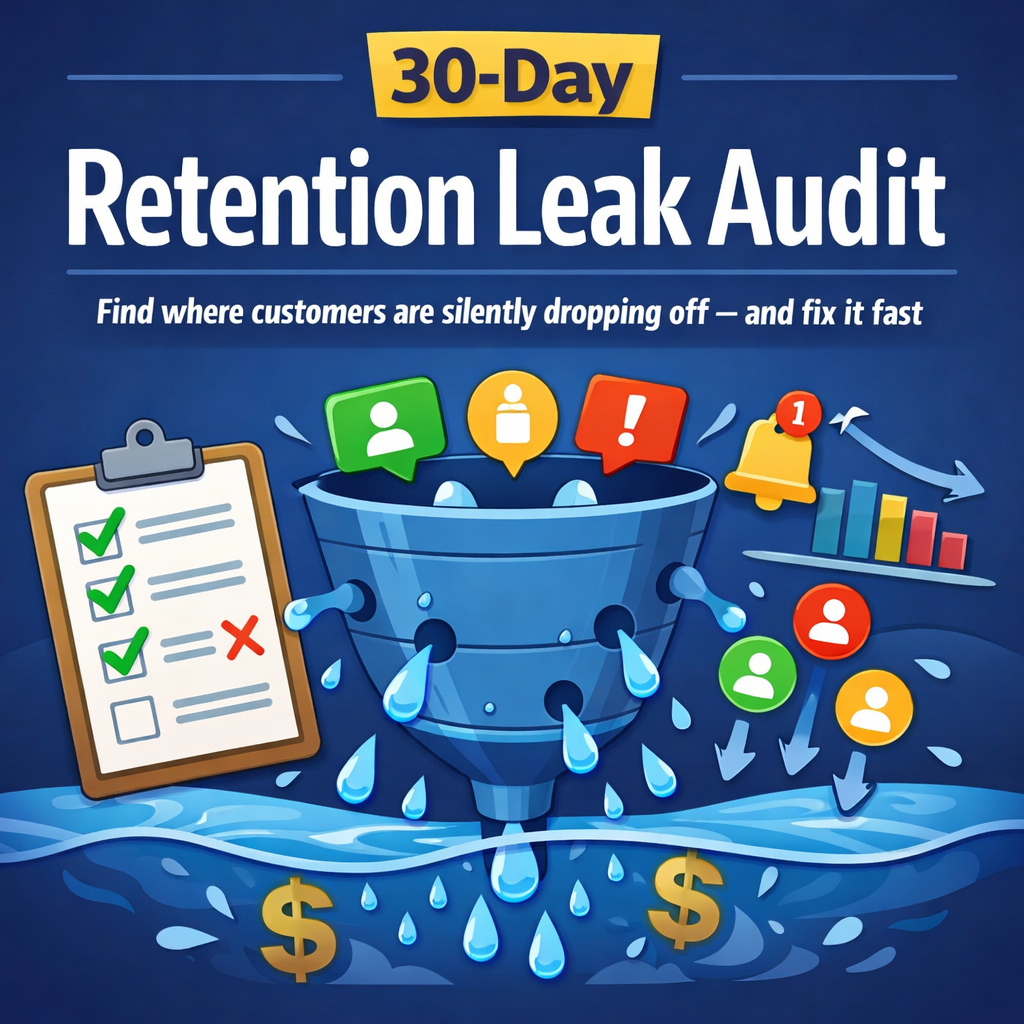
Your next customer may already be in your database
If you cannot clearly answer how many customers went quiet in the last 30 days, your growth strategy is still exposed. Auto Re Engage helps you detect risk early, recover revenue in time, and make every acquisition rupee work harder.