
Retention Intelligence
How Smart Service Businesses Lose Customers Silently (And What To Fix First)
A practical framework to detect hidden churn before recurring revenue starts dropping visibly.
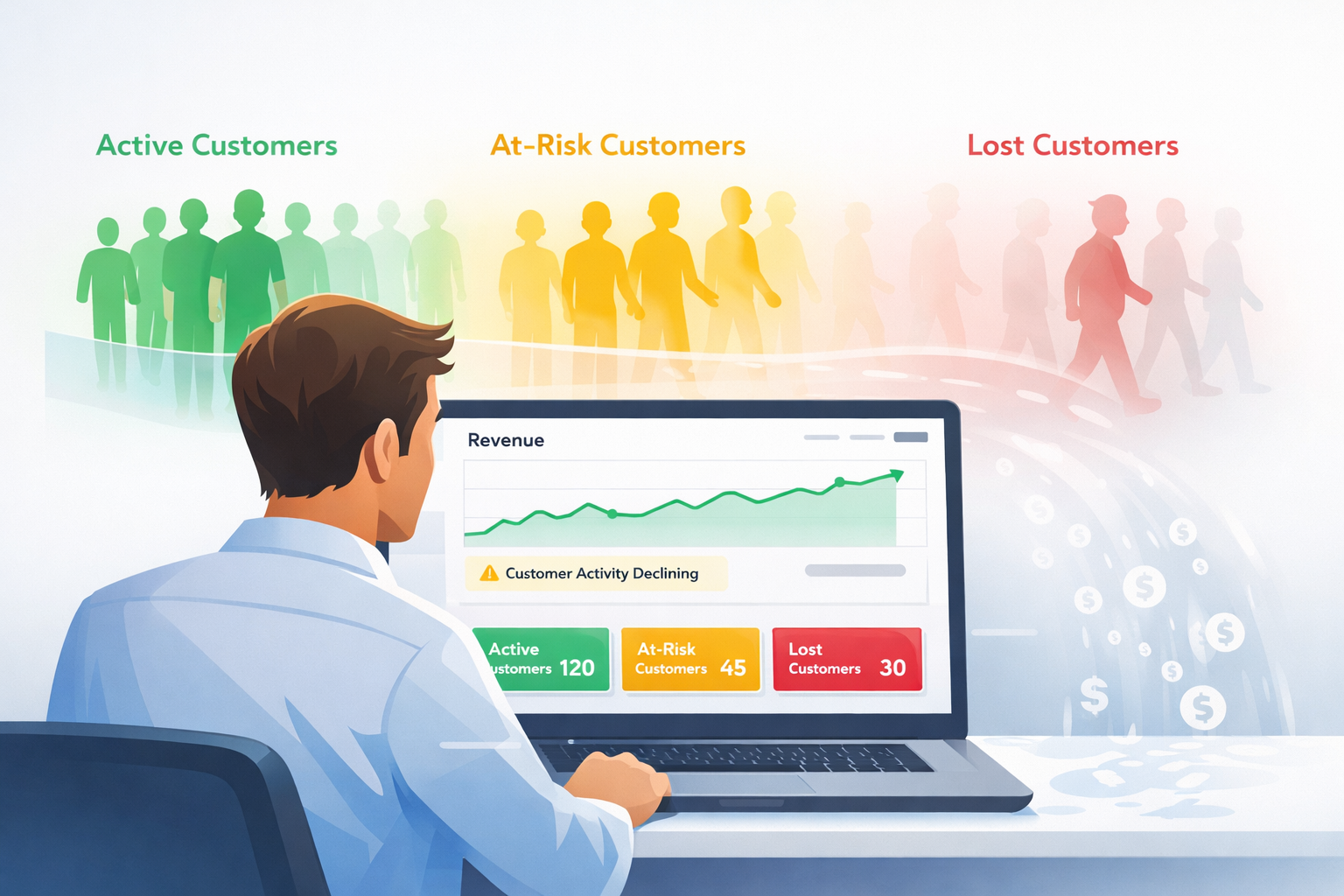
The Hidden Churn Problem
Local service businesses usually do not lose customers in one obvious event. They lose them gradually. A regular gym member starts visiting less. A salon client delays rebooking. A coaching student misses sessions. No formal cancellation happens, but engagement drops month by month.
This is hidden customer churn. It stays invisible until recurring revenue starts declining. That delay is the real risk. If you identify churn only after revenue drops, your recovery window is already smaller.
Why Smart Businesses Still Lose Customers
- No inactivity tracking: teams know sales totals, but not who quietly stopped showing up.
- No visit monitoring rhythm: behavior data exists, but nobody reviews it weekly.
- No retention system: outreach is ad hoc, not rule-driven.
- No automated follow-ups: by the time staff notices a drop, recovery is harder.
These gaps are operational, not motivational. Owners care about customer retention, but manual tracking across hundreds of customers is inconsistent and easy to delay.
The Silent Churn Cycle
Most businesses lose customers through the same pattern:
- Customer visits less frequently.
- Business takes no immediate action.
- Customer forgets the routine and emotional connection.
- Customer leaves permanently, often without telling you.
Breaking this cycle at step 1 or 2 is far cheaper than trying to recover customers after step 4.
Real Business Examples
Gyms and fitness studios
A member who attended 3 to 4 times a week drops to once every two weeks. No alert triggers. At renewal time, they do not continue.
Salons
A client with a 4-week rebooking habit delays to 7 weeks. Then 10. Without proactive outreach, they silently switch to another salon.
Clinics
A patient misses a follow-up visit. Then another. Without reminder rules, treatment continuity breaks and retention drops.
Coaching institutes and training centers
Attendance falls, but no structured escalation happens. By the time staff calls, the student is already disengaged.
A Practical 5-Step Framework to Detect Hidden Churn
Step 1: Track visit frequency
Start with one metric: days since last visit (or session/appointment). Add 30-day frequency trend. This gives early warning before billing impact appears.
Step 2: Define inactivity thresholds
Set clear rules for early drift, at-risk, and lost states based on your business model. Example: gym member no-visit for 10 days = at-risk; no-visit for 16+ days = lost.
Step 3: Segment customers
Create simple cohorts: Active, At-Risk, and Lost. Add a VIP At-Risk tag for high-value customers so priority follow-ups happen first.
Step 4: Trigger re-engagement campaigns
Send timely, personalized messages through channels customers actually respond to, especially WhatsApp for local service businesses.
- Friendly check-in
- Benefit reminder
- Clear next-step CTA
Step 5: Measure recovered revenue
Track more than message count. Measure reactivated customers, time-to-return, and recovered revenue. This shows whether your customer retention strategies are producing business outcomes.
Why Most Businesses Fail to Do This Manually
Manual workflows usually break at scale. Sheets become outdated, follow-ups are delayed, and segmentation changes are missed. Even disciplined teams struggle to run this daily. That is why businesses often know what to do, but still lose customers silently.
How Automation Solves the Problem
Automation closes the gap between detection and action. A good system continuously monitors behavior, flags inactivity, updates segments, and triggers outreach without waiting for manual review.
The result is faster intervention, better consistency, and clearer visibility into recoverable revenue.
The Revenue Impact of Customer Retention
Retention is usually more profitable than acquisition because recovered customers are faster to reactivate than new customers are to acquire.
Example: if a gym improves retention by just 2 percentage points, that can preserve dozens of memberships per year, often translating into meaningful recurring revenue with less marketing spend.
Conclusion
Hidden churn is a silent revenue leak, but it is fixable. Start with behavior tracking, define inactivity thresholds, and act before customers fully disengage. The earlier you detect risk, the easier and cheaper recovery becomes.
Keep reading
If you want a deeper breakdown of why customer loss is usually gradual, read Why Businesses Lose Customers Without Realizing. You can also visit the Blog Hub for the latest retention playbooks, and review AutoReEngage features to see how this workflow runs in production.
Turn this framework into action
AutoReEngage helps service businesses detect inactive customers early and automatically send WhatsApp re-engagement messages to recover lost customers before churn becomes permanent.