
Retention Intelligence
Why Businesses Lose Customers Without Realizing and How to Catch Silent Churn Early
Most customer loss is gradual, not dramatic. This guide explains where silent churn starts and how to stop it before recurring revenue slips.
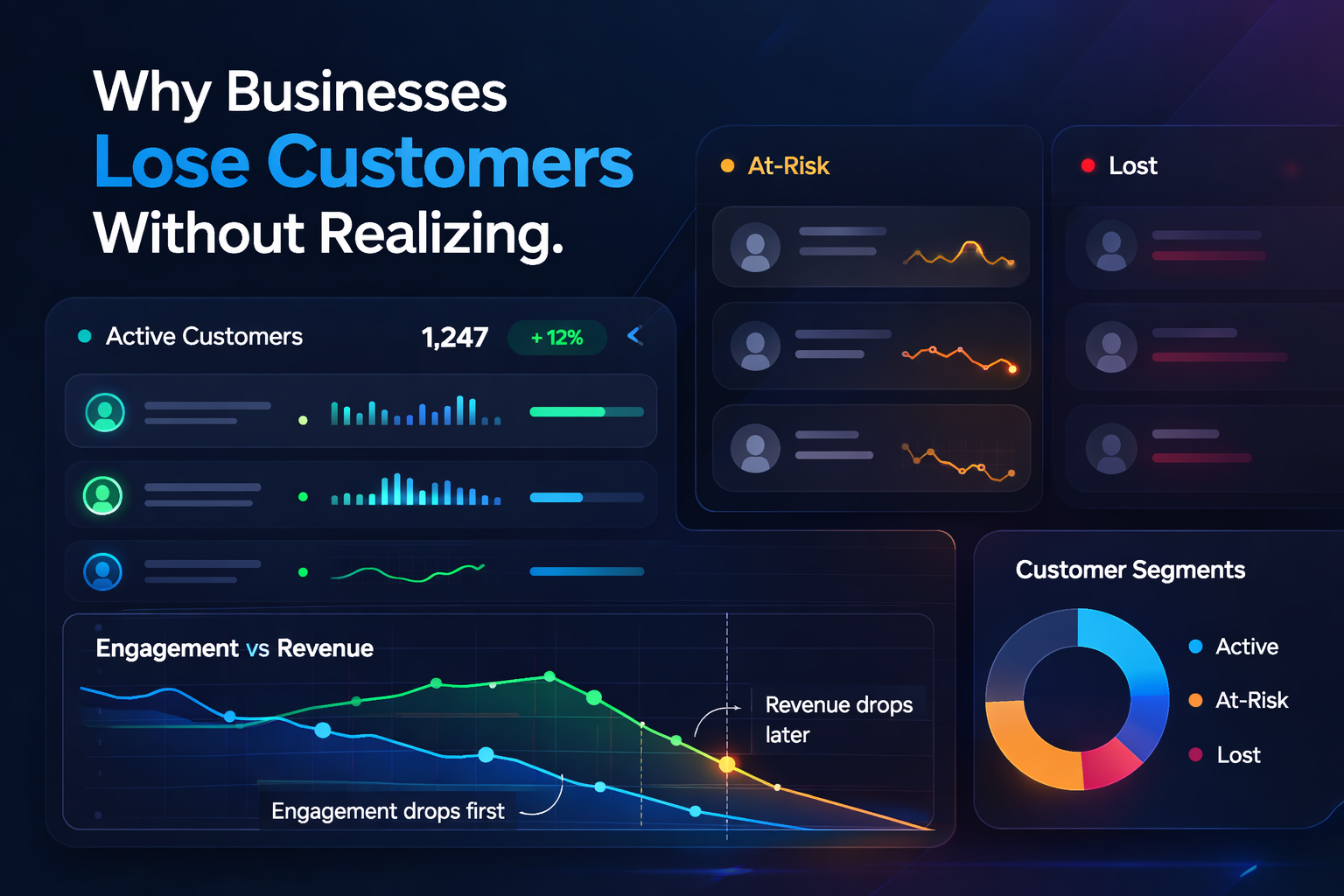
Most businesses do not wake up one morning and suddenly lose half their customers. What usually happens is quieter. A few regulars show up less often. A predictable pattern turns irregular. Follow-ups do not happen on time. Revenue still looks acceptable, so urgency stays low.
Weeks later, the dip appears in monthly numbers. By then, the behavior that caused it has already hardened. That is why businesses lose customers without realizing it: the earliest warning signs are behavioral, but most teams only react when financial signals become obvious.
Why Businesses Lose Customers Without Realizing: The Visibility Gap
Customer retention problems usually start in a visibility gap, not a service quality catastrophe. Owners and operators are busy serving clients, managing staff, running promotions, and solving daily issues. They can tell you total bookings, monthly sales, and lead volume. But many cannot answer a critical question: Which customers are quietly becoming inactive right now?
In repeat-visit businesses, customer loss is often gradual and silent. A customer who once had a habit with your business starts drifting from that rhythm. They do not complain. They do not always cancel. They simply visit less, respond less, and return later than expected until they do not return at all.
This is not a small reporting issue. It is where silent customer churn turns into lost recurring revenue.
The Difference Between Visible Churn and Silent Churn
Visible churn is the event most teams recognize: cancellation, contract termination, or explicit exit. Silent churn happens before that event. The customer is still in your database, but their behavior says the relationship is weakening.
Snippet-friendly answer: what is silent customer churn?
Silent customer churn is the gradual decline in customer engagement before a formal cancellation or obvious revenue drop appears.
- Visit frequency drops.
- Expected rebooking windows are missed.
- Attendance weakens before cancellation.
- Follow-up appointments are skipped.
- Response to reminders declines.
If you only track who canceled, you are measuring churn too late.
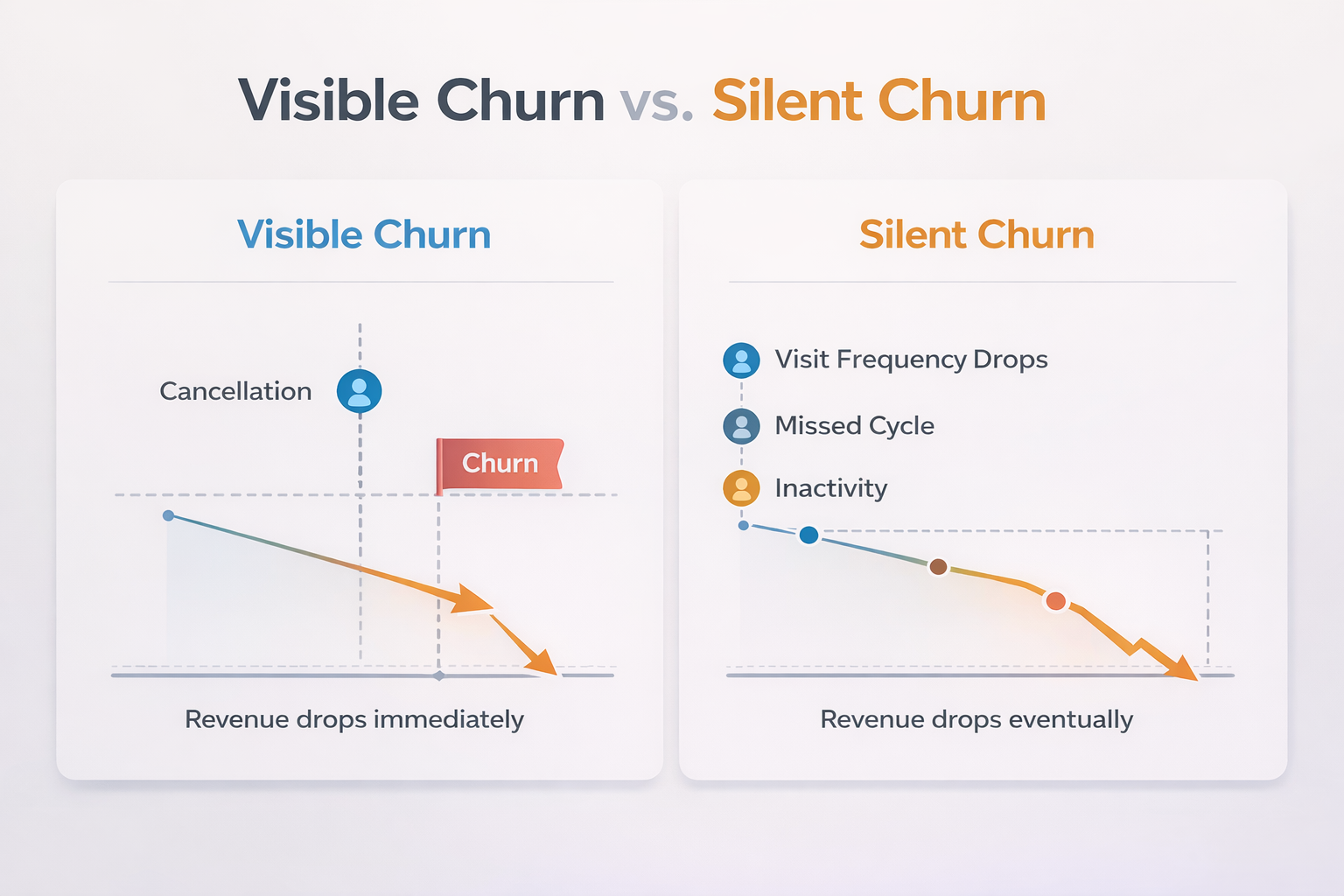
Why Revenue Drops Too Late to Be an Early Warning Signal
Revenue is essential, but it is a lagging indicator. It confirms what already happened. It rarely warns you early enough to prevent churn.
In most retention breakdowns, the sequence looks like this:
- Behavior shifts first.
- Inactivity accumulates.
- Customer relationship weakens.
- Revenue impact appears last.
That is why teams feel surprised by declines that were technically visible for months. They were monitoring totals, not trajectories.
A useful rule for operators: revenue is the scoreboard, not the smoke alarm.
The Hidden Patterns Businesses Fail to Track
Most businesses have customer data, but not customer churn detection. They can see transactions and appointments, yet they cannot quickly identify customer risk.
The most common blind spots are simple:
- No clear inactivity threshold for each service type.
- No list of customers overdue from their normal repeat cycle.
- No weekly review of at-risk customers.
- No segmentation into active, at-risk, and lost customers.
- No trigger-based follow-up process.
When these are missing, businesses mistake data volume for visibility. They know many things about customers, but not the one thing that predicts churn early.
Why Local Service Businesses Are Especially Exposed
Repeat-visit businesses are structurally more vulnerable to silent churn. Gyms, salons, clinics, fitness studios, coaching institutes, and training centers depend on habit, routine, and repeat behavior to protect recurring revenue.
In these models, one missed visit is not always a problem. A pattern of missed visits is. The risk grows when nobody is accountable for watching those patterns consistently.
In other words, inactivity is not neutral in a repeat-visit business. It is often an early warning.
Real Examples from Gyms, Salons, Clinics, and Coaching Institutes
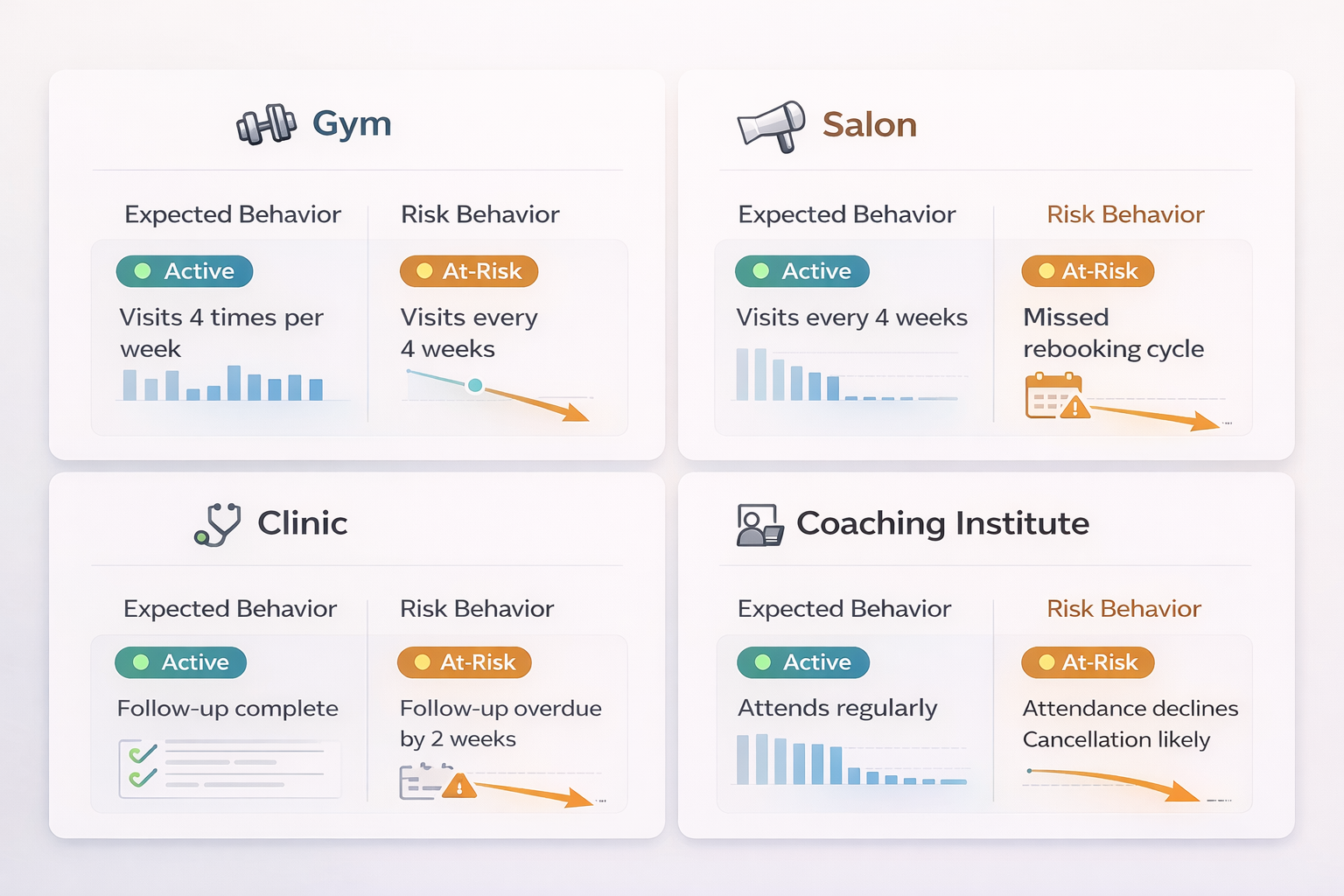
Gym example: attendance decline before cancellation
A member starts strong at four visits a week. Over six weeks, usage drops to one weekly visit. No one reaches out because the membership is still active. By renewal, motivation is gone, and the member leaves.
Salon example: missed repeat cycle turns into churn
A client who usually rebooks every five weeks does not return in week six or seven. The business does not flag the delay, assuming the client is busy. By week nine, she has already switched providers.
Clinic example: missed follow-up weakens continuity and retention
A patient needs a 30-day follow-up. The date passes without reminder escalation. The patient delays care and stops returning regularly. The clinic loses both outcomes continuity and predictable repeat revenue.
Coaching institute example: attendance drop before withdrawal
A student misses one class, then two, then starts attending irregularly. Because no risk segment exists, staff reacts only when a cancellation request arrives. By then, re-engagement is harder and requires far more effort.
Different industries, same pattern: behavior drift appears first and formal churn appears later.
The Operational Reasons Businesses Miss Retention Problems
Most teams do care about customer retention. They are not careless. They are overloaded and operating without a reliable system.
Manual tracking fails as customer volume grows because it depends on memory, spare time, and perfect execution during busy days.
- Spreadsheets get outdated quickly.
- Follow-up lists are inconsistent across staff shifts.
- Outreach quality varies by who is on duty.
- Risk checks get postponed when operations are full.
This is why manual customer retention strategies feel strong one month and fragile the next. The process is person-dependent instead of system-dependent.
Four Costly Assumptions That Let Silent Churn Grow
When retention systems are weak, teams often rely on assumptions that feel reasonable but hide risk. These assumptions are one of the biggest reasons how businesses lose customers goes unnoticed for too long.
Assumption 1: \"No complaint means no problem\"
Most customers do not report early disengagement. They simply reduce visits and attention. No complaint usually means low friction exit, not high satisfaction.
Assumption 2: \"They are still subscribed, so they are safe\"
Billing status can hide behavior decline. A paid member with collapsing engagement is often a near-term churn risk. Usage behavior predicts retention quality better than payment status alone.
Assumption 3: \"Front desk will remember who to follow up with\"
Even strong front-desk teams cannot remember every risk signal across hundreds of customers. Retention is too important to depend on memory, shift changes, or informal handoffs.
Assumption 4: \"We can fix this next month\"
Delay is expensive in retention. Every extra week of inactivity lowers return probability. A weak habit is recoverable. A broken habit is harder and costlier to rebuild.
A Weekly Retention Review Rhythm for Busy Teams
You do not need an analyst team to improve customer churn detection. You need a simple cadence that runs every week without debate.
A practical weekly rhythm looks like this:
- Monday: review at-risk and newly inactive customers by location or service line.
- Tuesday: trigger re-engagement workflows for at-risk cohorts.
- Wednesday: assign manual follow-ups for high-value accounts or VIP customers.
- Thursday: review response rates, bookings recovered, and no-response cohorts.
- Friday: track revenue-at-risk trend and segment movement versus last week.
This rhythm keeps retention visible even during operationally heavy weeks. It also reduces the tendency to treat churn as a monthly postmortem exercise.
A useful internal rule is simple: if a customer moved from active to at-risk, the business should know within days, not weeks.
What Businesses Should Track First
You do not need dozens of metrics to improve retention. You need a small set of leading indicators that reveal churn risk early.
- Visit frequency trend per customer.
- Days since last visit, session, or booking.
- Expected repeat cycle by service type.
- Missed follow-up or rebooking windows.
- Customer movement across active, at-risk, and lost segments.
These indicators create actionable visibility, especially when reviewed weekly.
If you want a practical companion guide, see How Smart Service Businesses Lose Customers Silently (And What To Fix First).
A Practical Framework for Early Customer Churn Detection
The framework below is designed for local service teams that need clarity and consistency, not complexity.
1) Track visit frequency
Establish each customer's normal engagement rhythm. Without baseline frequency, you cannot identify meaningful decline.
2) Define inactivity thresholds
Set thresholds by business type. A salon, gym, clinic, and coaching center all have different expected return patterns.
3) Segment active, at-risk, and lost customers
Segmenting customers is essential because each state needs a different response and urgency level.
4) Trigger follow-up actions
Build timely re-engagement workflows for each segment. At-risk customers should get personalized, context-aware follow-up before they become fully inactive.
5) Measure recovered customers and revenue
Track who returned, how fast they returned, and how much recurring revenue was protected. Improvement is easier to sustain when recovery is measurable.
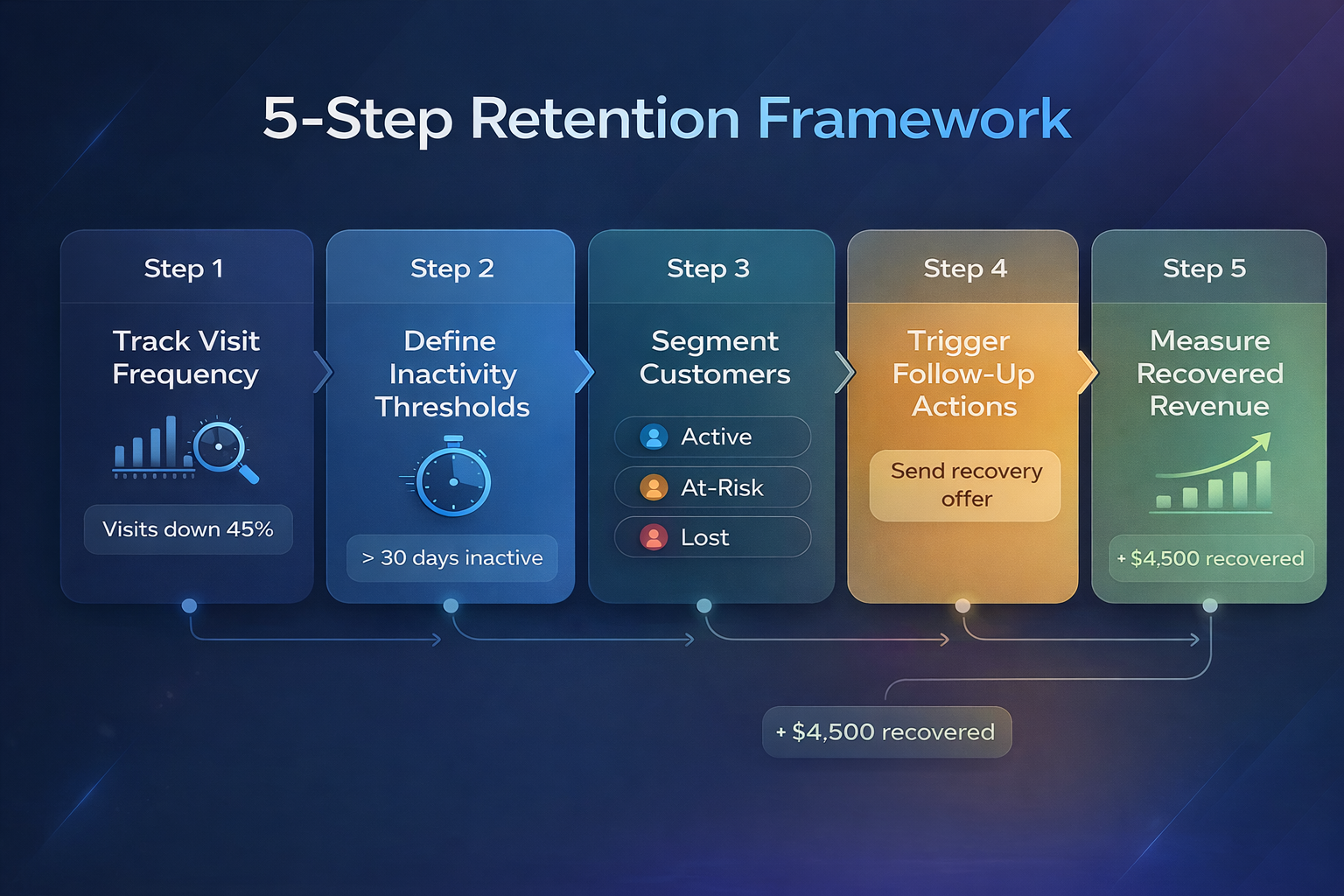
Key takeaway: Silent churn is a hidden revenue leak, not just a customer list problem. Businesses that detect inactivity early and act consistently protect more recurring revenue with less effort.
Why Segmentation Matters More Than Most Teams Expect
Segmentation is where customer data becomes operationally useful. Without segmentation, everyone looks equally healthy until churn becomes obvious. With segmentation, teams know exactly where to focus.
Active customers need routine nurturing. At-risk customers need immediate, relevant intervention. Lost customers need structured win-back campaigns.
This prevents the common mistake of treating all customers the same while risk is unevenly distributed.
For a strategic perspective on the business impact of retention-led growth, review the pricing economics of customer recovery.
Why Acting Early Is More Profitable Than Reacquisition
Many businesses spend heavily to replace customers they could have retained with earlier outreach. Reacquisition starts from zero trust and usually requires higher marketing cost. Early intervention starts with an existing relationship and lower friction to return.
In practical terms, a timely message to an at-risk customer often preserves months of future revenue, while reacquiring a lost customer may cost multiple times more and still fail.
This is why retention work should be treated as margin protection, not only customer support.
How Modern Retention Systems Solve the Problem
The real issue is not awareness. Most teams already know they should follow up more consistently. The issue is execution at scale.
Modern retention systems solve this by automating the sequence between detection and action: behavior monitoring, risk classification, and personalized outreach.
This is exactly where AutoReEngage fits. It helps local service businesses detect inactive customers, identify at-risk customers before visible decline, segment active/at-risk/lost states, and run personalized re-engagement workflows that reduce silent customer churn.
Instead of waiting for monthly revenue shock, teams get earlier signals and a consistent way to act.
For a hands-on playbook, you can also read our related guide: How Smart Service Businesses Lose Customers Silently (And What To Fix First).
For recovery-focused execution details, explore AutoReEngage workflow features.
Retention Metrics That Can Mislead Good Teams
Not every positive-looking metric reflects healthy retention. Some numbers create confidence while silent churn grows underneath.
Total customers in database
A large customer list can hide a shrinking active base. If inactive customers are not segmented, list size becomes a vanity metric.
Monthly revenue without engagement context
Stable revenue in one month can mask behavior decline that surfaces later. Without frequency and inactivity signals, revenue alone can delay action.
Campaign sends instead of campaign recoveries
Sending more messages does not guarantee retention improvement. Recovery rate, return rate, and time-to-return are better indicators of impact.
Cancellation count only
Cancellations are the final stage of churn, not the first. Teams that monitor only cancellation count often miss the larger at-risk segment that is still recoverable.
Strong customer retention strategies combine behavior indicators, segment movement, and revenue outcomes. That combination helps operators act early with confidence.
Conclusion: Why Businesses Lose Customers Without Realizing
Businesses rarely lose customers in a single dramatic moment. They lose them gradually, through weakened habits, missed follow-ups, and untracked inactivity.
That is why businesses lose customers without realizing it: the signals are visible in behavior, but often ignored until revenue makes the issue unavoidable.
If you run a repeat-visit business, silent customer churn is not a side issue. It is one of the biggest hidden threats to stable growth.
The upside is clear. Track the right behaviors. Segment customer risk. Intervene early. Build consistent workflows. When detection improves, customer retention becomes proactive instead of reactive.
Want a smarter way to catch churn before revenue drops?
AutoReEngage helps local service teams detect inactive customers, prioritize at-risk segments, and run recovery workflows before churn becomes obvious.